As an Amazon Associate, we earn from qualifying purchases. Some links on this site are affiliate links at no extra cost to you. Our recommendations are based on thorough research and editorial judgment.

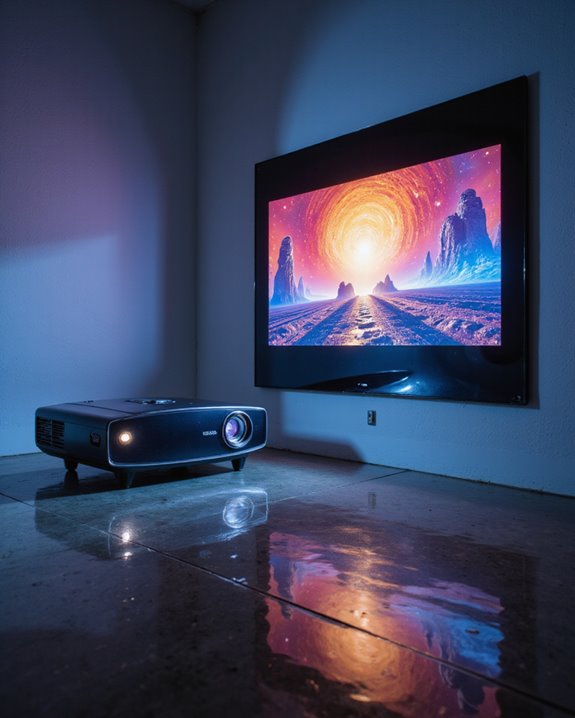
Will a Projector Work on a Mirror for TV Displays?

Standard mirrors make poor projection surfaces due to their specular reflection properties, which create significant image quality issues. The mirror’s surface causes hotspots, uneven brightness, and distorted visuals that diminish viewing quality. Left-to-right image reversal and limited viewing angles further complicate the setup. Professional TV mirror displays with specialized coatings offer superior alternatives for those seeking mirror-based viewing solutions. Understanding the technical challenges reveals why specialized display technologies prove more effective.
Key Takeaways
- Projectors can work on mirrors but create significant viewing challenges due to specular reflection and uneven light distribution.
- Standard mirrors cause image reversal, hotspots, and color distortion, making them unsuitable for high-quality projection displays.
- Limited viewing angles and excessive glare from mirror surfaces severely restrict optimal viewing positions for audiences.
- Proper alignment between projector, mirror, and viewer is crucial but difficult to maintain for consistent image quality.
- Specialized TV mirrors and smart displays offer superior alternatives with better clarity and fewer technical limitations.
Understanding Mirror Reflection Properties in Projection
You may be interested
When projecting onto a mirror, understanding the fundamental properties of reflection becomes essential for achieving ideal display quality. The mirror’s reflective surface follows a strict rule where reflection angles match incoming light angles, making proper positioning vital for viewers to see the display clearly. A key challenge lies in the mirror’s specular reflection, which means it reflects light in a focused beam rather than scattering it like a projection screen. This characteristic creates potential visibility issues for viewers positioned away from the optimal viewing angle. The mirror can create blinding reflections from the projector’s lamp during operation. Additionally, mirrors naturally reverse images left-to-right, requiring adjustment of projector settings to display content correctly through image inversion. The setup demands careful consideration of both projector placement and viewer positioning to guarantee everyone can see a bright, clear picture without distortion or dimming. Moreover, the reflection properties of mirrors can impact the brightness and clarity of the projected image, necessitating strategic placement to minimize glare and maximize visibility.
Why Standard Mirrors Fall Short as Projection Screens
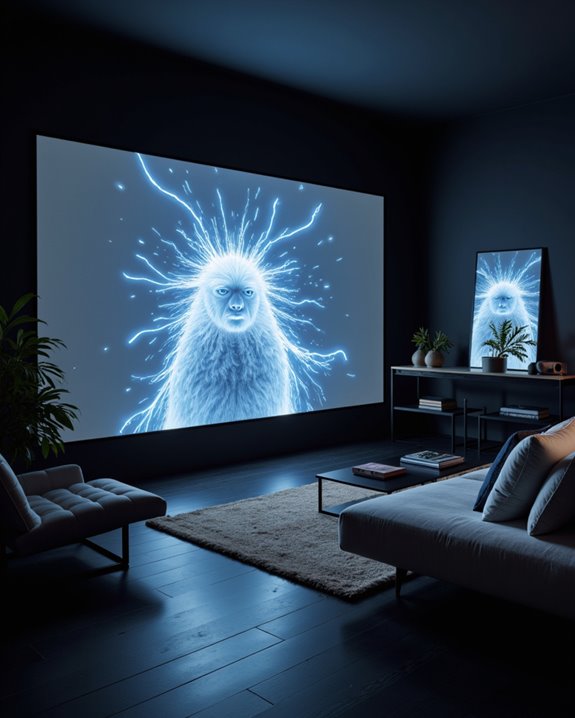
Standard mirrors present significant drawbacks when used as projection surfaces, despite their reflective properties. While historical applications of mirrors in optical devices have shown promise, they fall short in modern projection needs due to fundamental limitations in their design and construction.
The primary issues stem from mirrors’ uneven reflection quality and poor light distribution, which create inconsistent image brightness across the surface. Specialized projection screens with mirror-reflective surfaces offer significantly better light control with gain factors between 1.5 and 2.0. These problems become particularly noticeable in aesthetic considerations for home theater setups, where image quality is paramount. Standard mirrors also struggle with:
- Excessive glare and hotspots from their glass surface
- Color distortion due to reflective coatings
- Limited viewing angles compared to specialized screens
Additionally, the lack of controlled light reflection in standard mirrors hampers their ability to produce clear, vibrant images, making them unsuitable as projection surfaces. Unlike purpose-built projection screens, mirrors lack the technical specifications necessary for ideal image display, such as controlled gain levels and speckle reduction properties.
Recommended Products

CONVENIENT TO STORAGE AND CARRY : Compact one-piece,lightweight and folding design. You can fold the projector screen in small size and put it in your backpack or suitcase
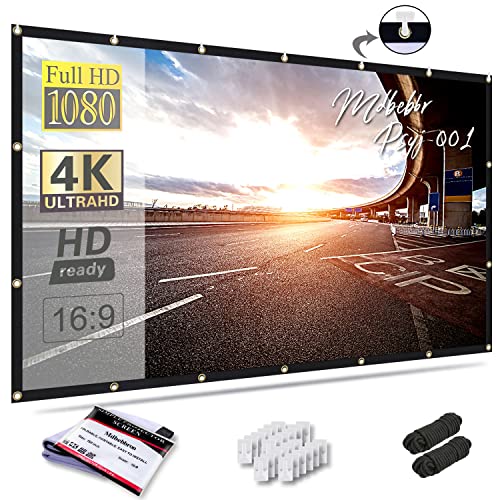
CONVENIENT TO STORAGE AND CARRY : Compact one-piece,lightweight and folding design. You can fold the projector screen in small size and put it in your backpack or suitcase

Projection Alarm Clock--The projector of the Alarm clock can be rotated ±90°, and the time graph can be flipped 180°; 4 level brightness adjustable, and the effective projection distance is 1.64-11.4 feet (0.5-3m), which can clearly project the time the best place on the wall or ceiling, allowing you to easily watch the time.
The Technical Challenges of Mirror-Based Displays
Creating effective mirror-based displays presents numerous technical hurdles that engineers must overcome for successful implementation. The challenges span multiple areas, from maintaining color accuracy to ensuring proper surface fineness of the mirror material.
The integration of cameras and sensors requires precise calibration and real-time processing to deliver clear images. Advanced systems now incorporate high-resolution HDR cameras to enhance visibility in challenging conditions. Optical engineering faces particular difficulties with waveguide efficiency and combiner optics, which must work together seamlessly to prevent distortion. Environmental factors also pose significant challenges, as the system needs to maintain consistent performance across varying light conditions while preventing interference from external sources. Additionally, achieving precise surface fineness in mirror materials is critical to prevent image degradation and ensure sharp, clear visuals.
These technical obstacles require sophisticated solutions, including advanced AI processing and partial reflector arrays. Engineers must balance these elements while ensuring the system remains reliable, durable, and easy to maintain.
Recommended Products

Integrated & Easy Installation: The Jungle Leopard Starlink case fan features an integrated structure, allowing for effortless installation.Just one - line connection to the motherboard simplifies the wiring process, saving you time and effort during setup

360‑Degree Rotating Counter Top Design: This 360° rotating sunglasses display rack for retail spins fully so shoppers can browse styles from every angle. Built‑in top mirrors help customers view fitting effects while trying on eyewear.
Alternative Solutions for TV Display Projection
Given the technical challenges of mirror-based projection, modern technology offers several effective alternatives for achieving high-quality TV displays. Instead of dealing with problematic reflection patterns from standard mirrors, manufacturers like Séura have developed specialized TV mirrors with advanced mirror coatings that seamlessly integrate television displays into home decor.
These solutions include framed TV mirrors that vanish when powered off, smart vanity mirrors with high-brightness panels, and interactive touch screen displays. Products featuring 4K UHD resolution deliver exceptional picture clarity and sharpness that surpass standard projection methods. For those seeking wireless options, screen mirroring technologies like ClickShare Conference and 1001 TVs enable device-to-display connectivity without physical installation. Modern smart TVs also come equipped with built-in screen mirroring capabilities, supporting direct connections from mobile devices and computers. These alternatives eliminate the technical limitations of projector-mirror combinations while delivering superior image quality.
Impact of Light and Viewing Angles on Mirror Projection
When projecting images onto mirrors, the interplay between light sources and viewing angles considerably impacts the display quality. The presence of ambient light can notably reduce image visibility, while unwanted glare from external light sources may compromise the overall viewing experience. Effective glare mitigation often requires strategic placement of both the projector and mirror. The 4K input support allows for enhanced image quality when reflecting content onto mirror surfaces.
The viewing angle plays an essential role in image clarity and perception. Ideal results depend on maintaining proper alignment between the projector, mirror surface, and viewing position. Distortion can occur when the mirror isn’t perfectly flat or when viewed from non-ideal angles. Mirror orientation must be carefully adjusted to achieve the best possible image quality, taking into account factors such as the projector’s resolution and the room’s lighting conditions.
Recommended Products

【Projector Screen Fabric 100%】The projector screen is made of polyester high density silk, Projection screen offers sharper and brighter visuals. it supports 3D and HD movies with high color reflection
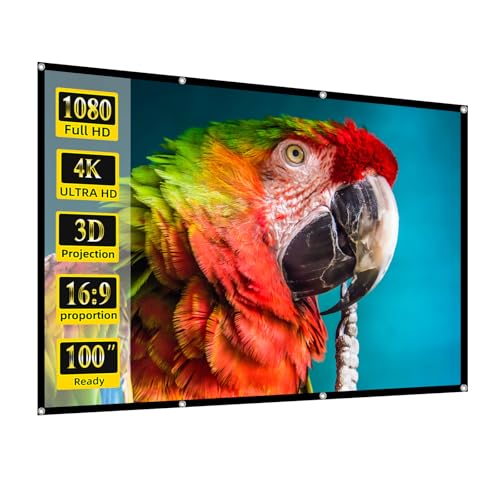
1. 【Lightweight & Foldable 16:9 Screen】 Designed for casual indoor and outdoor use. This high-density polyester projection screen offers a wide viewing angle. It is incredibly lightweight and folds compactly to fit in your own backpack, making it the perfect budget-friendly choice for camping, backyard movie nights, or temporary setups.

【Watch What You Want, When You Want!】 Remember when you could only really use your projector at night? That's a pain! This screen lets you watch movies, sports, or play games whenever the mood strikes, day or night. No more being tied to a dark room schedule – enjoy big-screen entertainment on your terms!
Specialized Mirror Technologies in Professional Displays
Recent advancements in specialized mirror technologies have revolutionized professional display capabilities through Digital Light Synthesis™, a groundbreaking 3D printing process. This innovative technique creates mirror microstructures using liquid polymers that are cured with light and oxygen, resulting in intricate honeycomb patterns consisting of over 14,000 struts and 7,799 nodes.
The technology’s polymer reflectivity can be precisely tuned at microscopic levels, offering potential applications in professional display systems. Elite professional athlete testing has validated the durability and performance of these advanced structures in real-world conditions. While currently proven in high-performance sports equipment, these specialized structures show promise for enhancing optical properties in display technology. The ability to customize density and surface characteristics could improve light reflection and image clarity in professional screens. However, adapting this technology for display purposes requires further research into optical compatibility and surface finishing techniques.
Recommended Products

Package contents: you will receive 50 pack glass retainer clips kit, including 50 pieces of glass panel retainer clips and 50 pieces of screws in this package, sufficient quantity and considerate assembly to meet your different daily needs

Package contents: you will receive 50 pack glass retainer clips kit, including 50 pieces of glass panel retainer clips and 50 pieces of screws in this package, sufficient quantity and considerate assembly to meet your different daily needs

6-Piece Acrylic Mirror Set: Includes 6 two way acrylic mirror sheets, each measuring 12 x 12 inch, providing sufficient material for building infinity mirror boxes, LED tunnel displays, and creative DIY art projects. Ideal for both small-scale designs and larger decorative installations
Frequently Asked Questions
Can You Make a DIY Rear-Projection Mirror at Home?
Amateur scientists everywhere rejoice: DIY rear-projection mirrors are indeed possible at home. With basic materials like wood, a quality mirror, and projector, anyone can create their own setup—assuming they survive the frustrating alignment process.
Will Projecting Onto a Mirror Damage the Projector’s Lens?
Projecting onto a mirror typically won’t cause lens damage when properly set up. However, incorrect mirror angles could create harmful beam reflections. Following proper setup guidelines guarantees safe mirror reflection without risking projector components.
Do Curved Mirrors Improve or Worsen Projection Quality Compared to Flat Ones?
Curved mirrors can both improve and worsen projection quality. While they may reduce mirror distortion in specific applications, their reflectivity effects require precise calibration. Flat mirrors generally provide more consistent, predictable image quality.
How Much Does Professional Projection Glass Cost Versus Regular Mirrors?
Professional projection glass cost typically ranges higher than regular mirror pricing, with standard mirrors costing $60-280 per square meter. Projection glass commands premium prices due to specialized coatings and enhanced durability features.
Can Multiple Mirrors Be Used to Extend Projection Distance in Tight Spaces?
Multiple mirrors can effectively extend projection distances in confined spaces, though careful mirror alignment is essential. Each additional mirror reduces projection brightness, requiring consideration of total reflective losses when planning complex setups.